
🩺 Flux Robotics completes first in-vivo magnetic deployment of certified stents
Flux Robotics is proud to announce a major milestone in the advancement of magnetic robotic navigation for vascular interventions. During a preclinical study conducted this week in Miami, Florida, the Flux 3 navigation system successfully performed its first in vivo stent navigation and deployment, using Bentley’s BeGraft stents. This marks the first-ever functional use of Flux 3 inside living vascular tissue, demonstrating precise magnetic steering, stable cannulation, and controlled stent placement under real biological conditions.
PRE-CLINICAL TRIALS
Flux Robotics
12/9/20252 min read
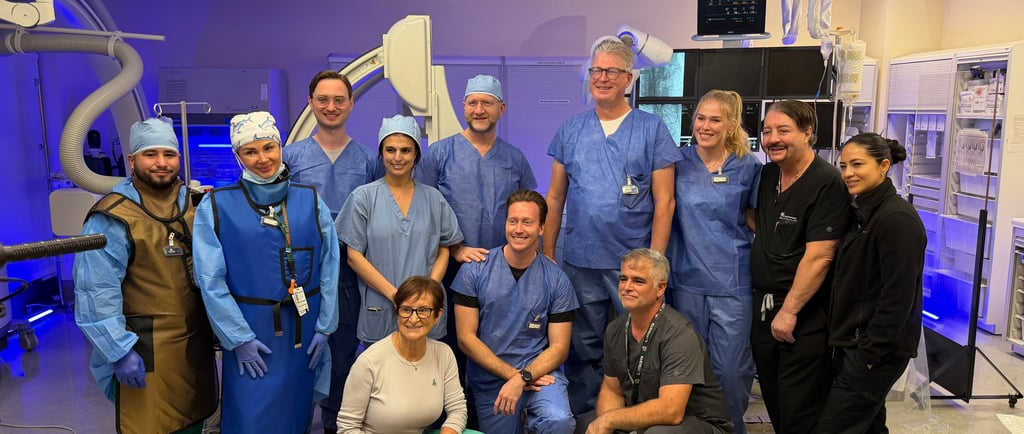
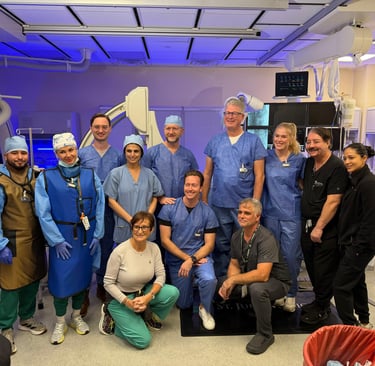
Flux Robotics is proud to announce a major milestone in the advancement of magnetic robotic navigation for vascular interventions. During a controlled in-vivo study conducted this week in Miami, Florida, the Flux 3 system successfully performed its first stent navigation and deployment, using Bentley’s BeGraft stents.
This marks the first-ever functional use of Flux 3 inside living vascular tissue, demonstrating precise magnetic steering, stable cannulation, and controlled stent placement under real biological conditions.
Why This Matters
For endovascular surgeons, navigating calcified or tortuous anatomy remains one of the most difficult challenges in vascular medicine - especially during cannulation and stent placement. The Miami study provided the first opportunity to evaluate Flux 3 not only as an engineering system but as a procedure-ready clinical tool.
Three independent KOL vascular surgeons evaluated the performance during the trial, and all highlighted the improvements in:
Cannulation accuracy
Wire stability during crossing
Stent alignment and deployment control
Each surgeon described the advancements as extremely important for future adoption in both peripheral and complex aortic procedures.
Key Results
Successful magnetic navigation through living vasculature
Controlled BeGraft stent deployment inside an arterial system
Stable navigation performance without arterial dissections
System compatibility with commercial vascular stents
Third validation of Flux 3’s mechanical, magnetic, and software performance under realistic physiological conditions
What This Enables
The Miami results significantly de-risk the next stages of development and accelerate our roadmap toward:
FDA Q-Submission discussions
Upcoming preclinical studies in Europe and the U.S.
First-in-human feasibility studies
Strategic partnerships with global stent and catheter manufacturers
Refinements to Flux 3’s usability, workflow, and clinical integration
This milestone is also a validation of the broader Flux platform approach, including our work on CTO crossing and fenestrated EVAR navigation.
A Collaborative Effort
This achievement was made possible through close collaboration between:
Our surgical partners and KOLs, including surgeons Dr. Robert Beasley (Palm Vascular Center, USA), Prof. Jean-Paul de Vries, (University Hospital Groningen, The Netherlands) and Prof. Anahita Dua (Harvard Medical School, USA).
Bentley (Dirk Reemers and Saskia Alber)
Miami Miller School of Medicine: Imaging Core for Research and Training (Ana Rojas and Jose Rodriguez)
Our engineering, regulatory, and clinical teams
We are deeply grateful to everyone involved in bringing this milestone to life!
What Our Partners Are Saying
Christoff Heunis (CEO, Flux Robotics):
“This was a defining moment for the team. Seeing Flux 3 navigate and deploy a stent inside living vascular tissue is the strongest validation yet of our platform. The feedback from all three KOLs - particularly around cannulation and stent placement - gives us great confidence as we prepare for regulatory interactions and the next phase of trials.”
Wimold Peters (CTO, Flux Robotics):
"During this trial, the control, stability, and procedural precision of our Flux Robotics magnetic guidewire performed exactly as intended by the engineering team. An important timestamp in the process of continuous innovation of the Flux system."
Robert Beasley (Vascular Surgeon, Palm Vascular, USA):
“I was so amazed at the ease of vessel cannulation and stent placement using the Flux 3 system in the study in Miami. All five vessel territories were successfully engaged in less than an hour by every participating vascular surgeon. I'm extremely excited for what the future holds for this unique and innovative technology.”
Jean-Paul de Vries (Vascular Surgeon, UMCG, NL):
“The Flux 3 system elevates endovascular procedures from unstable pushing guidewires to stable and safe pulling guidewires into arteries.”
Anahita Dua (Vascular Surgeon, Harvard Medical School, USA):
"The Flux robotic system removes the single most unpredictable step in endovascular repair - cannulation - transforming a variable, high-stress moment into a controlled, reliable workflow."
📩 Interested in collaborating on the next phase?
Reach out to us at contact@fluxrobotics.nl


Controlled Navigation. Predictable Outcomes.
Offices
Groningen
Blauwborgje 31
9747 AC Groningen
Netherlands
Enschede
Ariënsplein 1
7511 JX
Enschede
Netherlands
KvK: 87842165